Practical AI Strategies to Empower Your Growth
The rise of AI in the workplace is reshaping how we approach our jobs. For many knowledge workers, this technological revolution represents a significant shift – from being the primary doers of tasks to becoming directors of AI-powered processes. This transition isn’t just about learning new tools; it’s about fundamentally changing our mindset and approach to work. In this article, you’ll learn how to transition from a task-doer to an AI director, with practical strategies to enhance your productivity and future-proof your career.
Did you know? According to a recent McKinsey report, AI could automate up to 45% of work activities across all occupations, potentially freeing up significant time for more strategic tasks.
The Mind Shift: From Doing to Directing
One of the most significant changes in the AI-augmented workplace is the transition from task execution to strategic direction. This shift requires a new set of skills and a different approach to problem-solving.
In my experience as a marketing professional, this shift is particularly evident in content creation. I’ve found myself evolving from being primarily a writer to more of an editor and strategist. Topics and core ideas still originate from me, but I now leverage AI tools like Claude and Perplexity for initial drafts and research. This approach allows me to work smarter, not harder, focusing my energy on refining and strategically directing the content rather than starting from scratch.
Enhancing AI Understanding
To effectively direct AI systems, you need to enhance your understanding of their capabilities and limitations. This doesn’t mean becoming a programmer, but rather familiarizing yourself with AI concepts and how to work effectively with these tools.
Key AI concepts relevant to marketing include:
- Natural Language Processing (NLP): Enables AI to understand and generate human language, crucial for content creation and customer interactions.
- Predictive Analytics: Uses historical data to forecast future trends, essential for campaign planning and optimization.
- Machine Learning: Allows AI systems to improve their performance over time, enhancing various marketing functions like personalization and segmentation.
I’ve found that the biggest challenge in adapting to AI is education and understanding how to work with these systems. It’s a new way of thinking. In the past, interacting with software often involved technical jargon and steep learning curves. Now, it’s about understanding how AI works and how to converse with them to get the best output. It’s crucial to remember that AI output is all about context and goals. It’s an iterative conversation, not just a one-and-done prompt.
Practical Strategies for Adapting to AI at Work
1. Identify AI Opportunities in Your Role
Start by assessing your current responsibilities and identifying areas where AI could potentially streamline or enhance your work. In my approach, I think of a project and break it down into discrete tasks. Then I evaluate if that is something for AI. I try to weave AI in as much as possible because I’m a team of one, but now two if you count AI’s support.
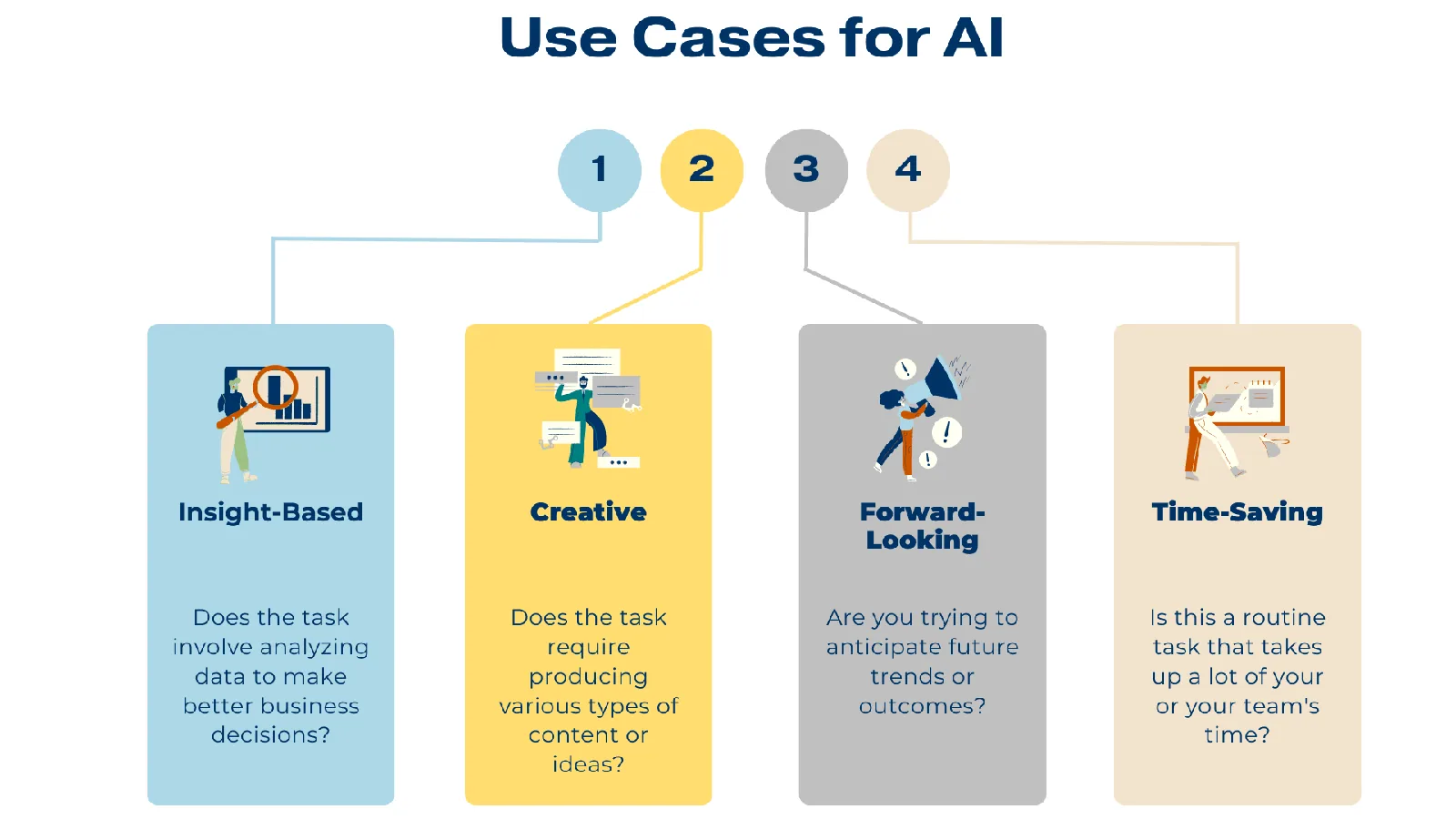
In particular, if a task is one of these, then it is likely a good use case for AI.
2. Collaborate with AI Tools
Begin incorporating AI tools into your workflow. My go-to AI tools are Claude, ChatGPT, and Perplexity. I use Zapier to bring it all together, integrating these AI tools into my existing workflows for maximum efficiency.
For example, I used to spend hours researching industry trends for our weekly newsletter. Now, I use AI to gather and summarize key information, allowing me to focus on analyzing the implications for our audience and crafting more insightful commentary. This has cut my research time by 60% while improving the quality of our content.
3. Continuous Learning and Upskilling
The AI landscape is constantly evolving, making continuous learning essential. Personally, I find that many cutting-edge conversations are happening on X (formerly Twitter). I follow many thought leaders there and then test-drive some of what they’re sharing. This technology is remarkably accessible even for non-technical folks.
To stay ahead of the curve:
- Set aside time each week to explore new AI tools and techniques
- Participate in online courses or webinars focused on AI in marketing
- Join AI-focused communities or forums to share experiences and learn from peers
Leveraging AI for Productivity and Innovation
AI can be a game-changer for productivity and innovation. Since starting Pallas Advisory last year, I’ve published weekly blogs and newsletters. There’s no way I could have maintained this pace without leveraging AI as my writing assistant.
Here’s a step-by-step breakdown of how AI has improved my content creation process:
- Idea generation: I use AI to brainstorm topic ideas based on current trends and our audience’s interests.
- Outline creation: AI helps me structure my thoughts and create comprehensive outlines.
- Initial draft: I prompt the AI to create a first draft based on my outline and key points.
- Editing and refinement: I review and edit the AI-generated content, adding my unique insights and experiences.
- SEO optimization: AI tools help me identify relevant keywords and suggest improvements for search engine visibility.
This process has reduced my content creation time by 40% while allowing me to maintain a consistent publishing schedule.
Another example is the AI Readiness scoring methodology I developed for SMBs. I’m no math wizard, and in the past, doing something like that would definitely have involved a third party to validate my logic and brainstorm the approach. But that wasn’t needed with Claude’s support. Again, it goes back to providing context, understanding the audience, and setting clear goals. To create something relevant to my audience, AI needs detailed input to be successful.
Focus on Human Skills
As AI takes over more routine tasks, human skills become increasingly valuable. These include creativity, emotional intelligence, complex problem-solving, and critical thinking.
In marketing, this shift allows professionals to focus on:
- Developing more creative and innovative campaign strategies
- Enhancing customer experiences through empathy and emotional intelligence
- Conducting deeper analysis of market trends and consumer behavior
- Crafting compelling brand narratives that resonate on a human level
In my view, knowing how to work with AI and understanding how these systems function will improve your output. That said, AI is just AI. We all bring unique perspectives and experiences – that’s what we need to develop and continue to nurture. Our experiences, judgment, soft skills like curiosity and leadership – those are the things to focus on. AI will eventually be smarter than all of us in many ways, but success in your career will depend on your humanity, not just the technology.
Overcoming Challenges in the AI Transition
Adapting to new ways of working can be uncomfortable. To ease the transition:
- Start small by incorporating AI tools into non-critical tasks
- Celebrate small wins and improvements in efficiency
- Share your experiences with colleagues to create a supportive learning environment
- Be patient with yourself and allow time for learning and adjustment
Measuring Success in an AI-Augmented Workplace
As we integrate AI more deeply into our work, how we measure success may need to evolve. In my experience, AI has impacted all aspects of my work. Since starting Pallas Advisory, everything is done with scalability in mind.
Key Performance Indicators (KPIs) for measuring success in AI integration:
- Time saved: Track the reduction in time spent on routine tasks
- Content output: Measure the increase in content production (e.g., blog posts, social media updates)
- Campaign performance: Monitor improvements in key metrics like engagement rates, conversion rates, and ROI
- Innovation index: Track the number of new ideas or strategies implemented
- Learning and development: Measure time spent on upskilling and the application of new AI-related knowledge
For instance, I wrote a blog article earlier this year about how social media was a real time suck for me. It was definitely creative and repetitive, so I knew it was a good use case for AI intervention. While I don’t have exact stats, I would estimate it has saved me about 10 hours a week just because I figured out a way to have AI help me. This time savings has allowed me to focus on more strategic initiatives and client interactions.
The Future of Work: Human-AI Collaboration
As we look to the future, it’s clear that the most successful professionals will be those who can effectively collaborate with AI. This doesn’t mean competing with machines, but rather leveraging AI to enhance human creativity, decision-making, and problem-solving.
My vision is for my experience to be shared with everyone else. I’ve picked this up rather quickly and wouldn’t consider myself highly technical. I want to enable everyone to be able to do this. It’s one of my core values – this tech shouldn’t just be for Silicon Valley insiders but for everyone. There are still many unknowns as to where this is going, so I wouldn’t even hazard a guess 5 years out on this stuff. For now, I want to focus on sharing my insights, experiences, and advice to make this technology accessible to everyone.
Wrapping Up
The transition from being a doer to a director in the age of AI represents a significant shift for knowledge workers. While it may seem daunting, this change offers exciting opportunities for growth, innovation, and career advancement.
By developing a strategic mindset, embracing continuous learning, and focusing on uniquely human skills, you can position yourself as an invaluable asset in the AI-augmented workplace. Remember, the goal isn’t to compete with AI, but to collaborate with it, leveraging its strengths while applying your creativity, empathy, and strategic thinking.
As you navigate this transition, stay curious, be open to new ways of working, and never underestimate the power of human ingenuity. The future of work is not about AI replacing humans, but about humans and AI working together to achieve unprecedented levels of productivity and innovation.
At Pallas Advisory, we’re committed to being your compass for success in this AI-driven landscape. We provide the knowledge, strategies, and tools you need to confidently harness the power of AI for sustainable business growth and resilient marketing careers.
Ready to Become an AI Strategist?
Take the next step in your AI journey by subscribing to our AI Strategist newsletter. Delivered every Wednesday, this newsletter is your weekly dose of AI wisdom tailored specifically for SMB decision-makers and marketers. Sign up for AI Strategist now and join a community of forward-thinking professionals mastering the art of AI-human collaboration!
P.S. Interested in test-driving AI Readiness? Click here to take the assessment.